The new presiding judge, Kevin Farmer, says he wants to begin trials in early June—but procedural and organizational issues could pose more delays
This report was penned by Aja Arnold with stringer reporting from local reporter and researcher Sam Barnes.

ATLANTA—On Wed., May 14, most of the 61 Stop Cop City RICO defendants returned to court for a status hearing with the new presiding judge on the case, Kevin Farmer. This was the first hearing with Farmer, who is taking over the case since the former judge, Kimberly Adams, was moved to family court. Judge Farmer says he’d like to start trials in early June with defendants divided into groups of five. This timeline could be delayed due to ongoing procedural and organizational issues.
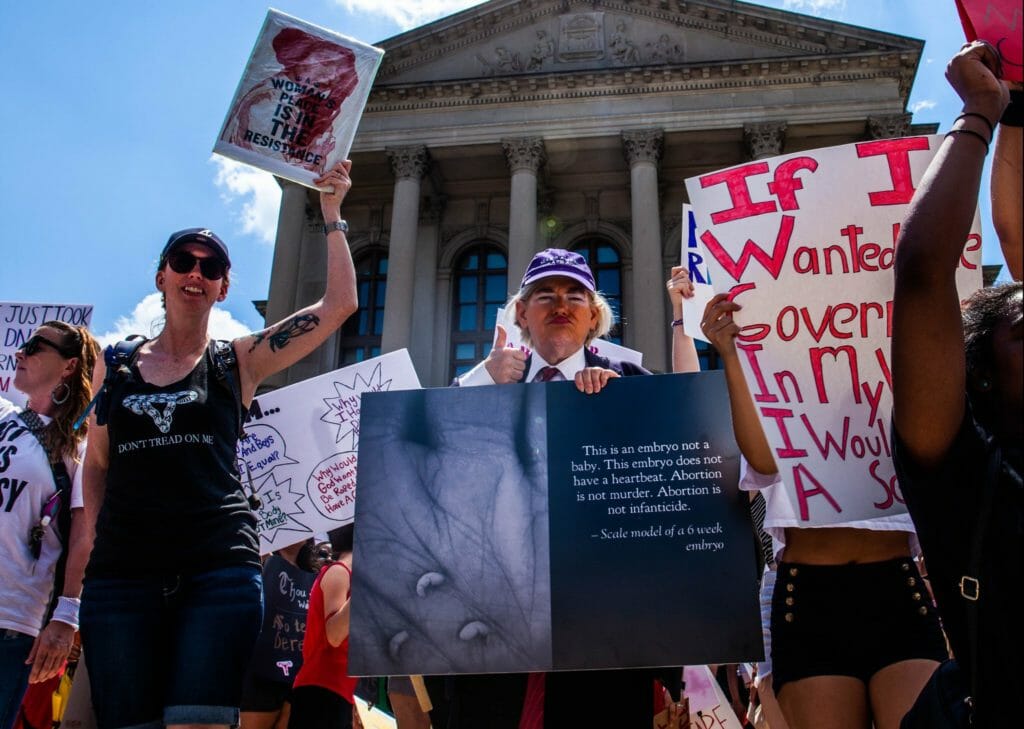
Georgia Attorney General Chris Carr issued the sweeping indictment charging 61 individuals with racketeering for their protest or perceived association with the movement against the massive $109M police militarization facility in Atlanta, colloquially known as “Cop City,” in August 2023. The plans for the facility garnered mass opposition amongst locals since it was introduced in Atlanta City Council in June 2021. The burgeoning opposition grew following the police killing of 26-year-old Manuel “Tortuguita” Paez Terán, who was shot by police at least 14 times in the forest in January 2023. Since then, the Stop Cop City movement has become a globally recognized effort.
Wednesday’s status hearing was the first time all 61 defendants were ordered to return to court since their November 2023 arraignment, with a few not in attendance due to traveling issues, concerns about ICE, and other reasons. A bench warrant was issued to one defendant determined to have not made a “good faith effort” to arrive at court. (One other defendant had a bench warrant issued in 2023.)
Judge Adams ruled on a set of demurrers—or, motions to dismiss—from the first trial group the night before the status hearing, denying the group’s request to quash the indictment. The motion detailed numerous issues with the indictment, including its violation of constitutionally protected activity under the First Amendment. There are over 250 more motions that remain unheard in the nearly two-year long case.
Ayla King, the 19-year-old defendant whose trial was scheduled to begin in January 2024, will resume trial when their attorney returns from leave in August. King’s trial was paused after their attorney filed a motion to dismiss, arguing that the courts violated Georgia’s speedy trial statute. The courts denied the motion to dismiss and ordered King’s trial resume with a new jury.
Judge Farmer ignores previous judge’s deadlines for discovery. Prosecution surprises defense with 57 more gigabytes of evidence.
Discovery issues were one of the biggest topics of discussion at the status hearing on Wednesday.
Last year, Judge Adams gave two verbal orders imposing deadlines for discovery, which the prosecution did not follow. Farmer did not enforce Adams’ verbal orders, citing a difference between verbal and written orders, but encouraged defense attorneys to brief him on why he should enforce them moving forward. On Wednesday, the prosecution announced that it was delivering another 57 gigabytes of discovery, in addition to the five terabytes of evidence that has already been delivered to the defense.
Farmer said he would provide written orders pertaining to discovery, but did not state any specifics at the status hearing.
New judge says all motions will be “particularized.” Defense attorneys have until May 30 to file any additional motions.
Over 250 motions have been filed since defendants’ arraignment in November 2023. While Judge Adams allowed defense attorneys to adopt one another’s motions wherever applicable, Judge Farmer announced on Wednesday that all motions would need to be “particularized.” Particularizing motions means that defense attorneys would no longer be permitted to adopt another motion, and that each motion would need to be argued individually, rather than at one time.
However, the defense argued that motions which affect all defendants should not be heard after some defendants have already been tried. While Farmer’s main concern appeared to be about efficiency of what he described as a “two-year long case that is going nowhere,” the defense argued that particularizing the motions has the opposite effect.
Judge Farmer plans to sever all cases, hindering a collective defense.
Farmer also said he plans to sever all 61 cases, meaning each case would be tried individually and not treated as a collective defense. Or, in other words, rather there being one case with 61 individuals, severing the cases means there are 61 individual cases. Sources say this, along with motions particularization, could cause complications for the defense and even more delays.
Some defense attorneys raised concerns on motions that Judge Adams had not yet ruled on, including the Atlanta Solidarity Fund’s motion to suppress the search and seizure of privileged communications. The ASF, a local nonprofit organization that provides bail funds and legal resources to those facing political repression, was raided in May 2023. Three ASF organizers, or the Sol Fund 3, were charged with money laundering and charity fraud. All 15 money laundering charges were dropped by the attorney general last September.
Sol Fund 3’s attorney, Don Samuel, filed a motion to suppress the seizure of devices that contained privileged communications. The motion was heard in Adams’ court, but not ruled on. Farmer said he would either rule on them from records and transcripts, or ask Adams to rule on them. Samuel clarified that if Farmer were to rule from the digitized transcripts, not all of the witness testimony was captured.
“I perceived the new judge’s attempt of organizing and scheduling an enormous case with 61 defendants, some cases in one stage, some in another … and he was trying to organize them to move forward,” explained defense attorney Xavier T. de Janon, who represents Jamie Marsicano in the case, in a statement to Mainline regarding the status hearing. “But all the issues we have been dealing with for almost two years now are emerging. We ended up right where we were before: all the motions sitting, no trial order cleared up, and no scheduling order still. It felt like we ended right back at square one.”